Everything about dice
The oldest game in the world. Roll them here — then read why 1 always sits across from 6.
PLAY NOW
What is a die?
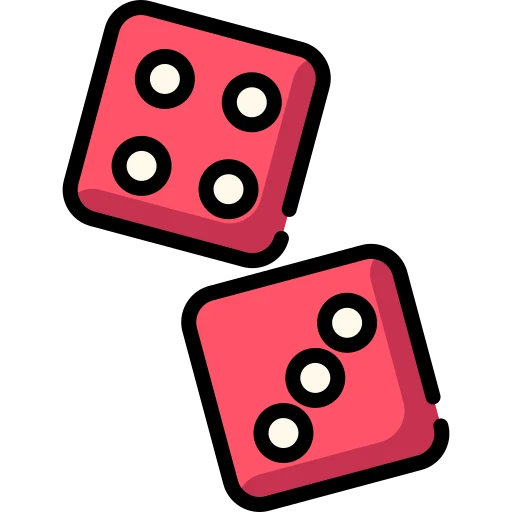
A die is a small cube with six faces, each marked with pips from 1 to 6. One throw gives you a result between 1 and 6. Nothing is simpler — and almost nothing is older — as a chance tool.
You meet dice in board games, tabletop RPGs, classroom draws, or a quick “who pays?”. On AmStramGram the roller is free, without stakes, and uses a cryptographic random source so each face really has one chance in six.
History & origins
The first “dice” were astragali: sheep or goat ankle bones with four usable faces. Antiquity already used them for play and for divination.
Greek myth credits Palamedes with inventing dice during the Trojan War, to keep soldiers busy. Romans loved them. Julius Caesar threw dice before hard calls, and “Alea jacta est” — the die is cast — still names a point of no return.
Cubic six-siders in bone, ivory, then plastic arrived later. Casinos now prefer transparent dice and strict checks. Cheating is as old as the object: loaded dice turned up in Pompeii, year 79.
Alea jacta est
Latin for “the die is cast”. Caesar’s line when he crossed the Rubicon. You use it whenever a choice cannot be walked back.
How it works here
On AmStramGram, rolling is straightforward:
- Pick how many dice — one die or several at once (up to 6).
- Roll — tap Launch and watch them tumble.
- Read the faces — each die shows a number from 1 to 6.
- Sum — with several dice, the total is added for you.
The generator is built so each face keeps a 1/6 chance. No “hot” die, no memory of the last throw.
The maths rule
On a standard die, opposite faces always add up to 7: 1+6, 2+5, 3+4. That layout keeps the cube balanced.
Did you know?
Pompeii dice
Archaeologists found loaded dice under the ash of 79 CE. Piping a die is not a modern casino trick — it is as old as the game.
Casino dice
Casinos use transparent dice and regular inspections. A serious casino die can cost hundreds of euros because balance is the product.
The word “random”
French aléatoire comes from Latin alea, “dice game”. The language still carries the throw.
Frequent questions
Everything you want to know about dice