Celtic Mythology: When Luck Is Wild Magic
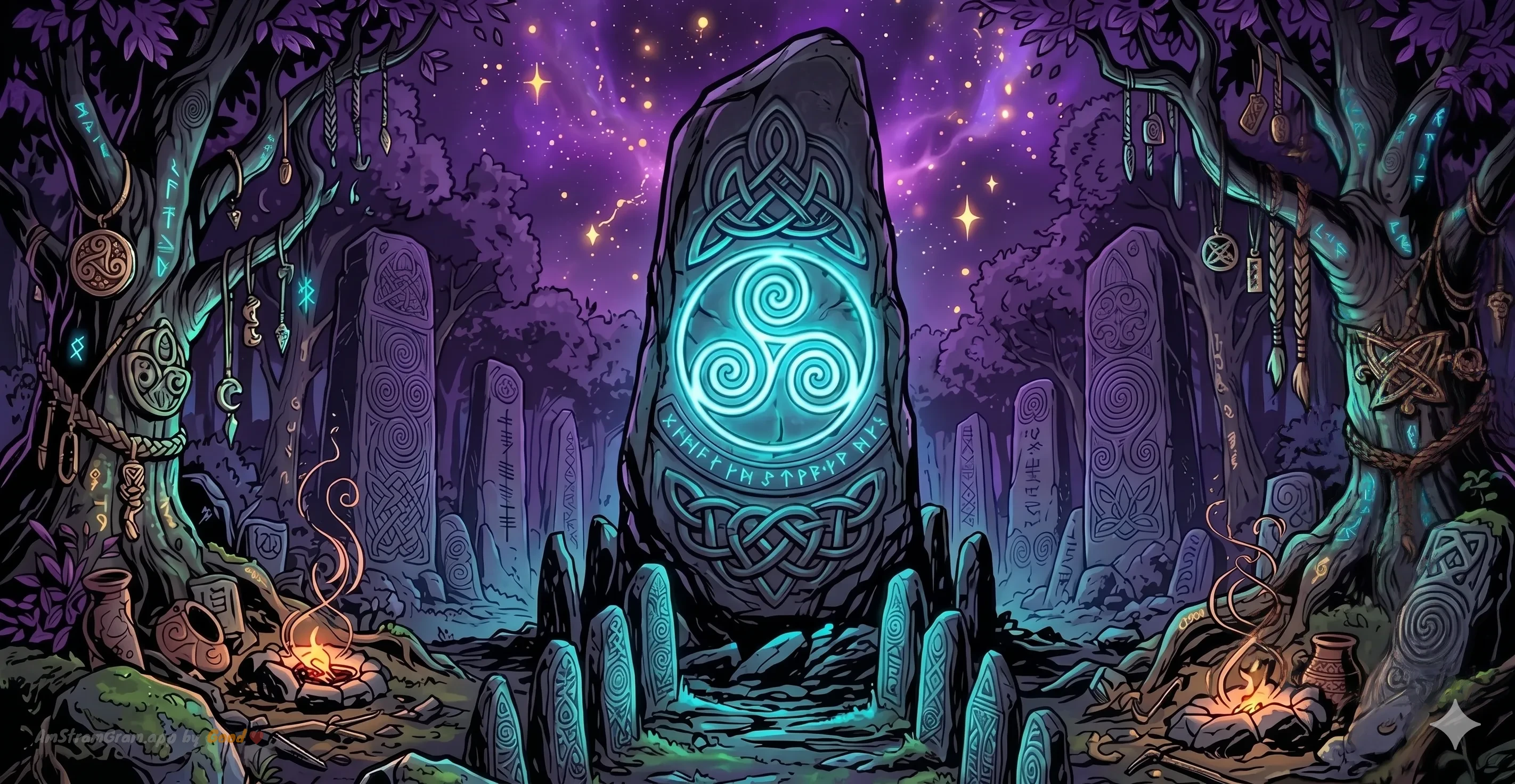
Unlike the Greeks, for whom fate is an inevitable straight line, the Celts saw life as an interlace — the famous Celtic knots. Luck is not blind: it is magical, wild, and smiles on those who know how to read the signs of the Otherworld.
In the Celtic traditions of Ireland, Wales and Gaul, destiny never appears as a thread stretched between two points. It looks far more like those Celtic knots carved on stones and illuminated manuscripts: a spiral without beginning or end, where each loop contains another. Luck, in this universe, is not distributed by a blind deity — it is the fruit of a living connection with the Otherworld, the parallel realm the Irish call the Sídhe.
The gods of the Tuatha Dé Danann — the divine beings who inhabited Ireland before humans — each embody a different facet of this wild fortune: inexhaustible abundance, brilliant cunning, prophetic intuition. To understand their myths is to grasp a whole philosophy of how one provokes their own luck by staying attuned to the deep rhythms of the world.
Explore the Deity Codex
Find Lugh, The Dagda, The Morrigan, Brigid, Cernunnos, Manannán and all deities from 7 great mythologies in our interactive Codex.
Abundance and Wealth: the cauldron and the forest
At the heart of Celtic cosmology, prosperity is never a limited resource. It springs from an inexhaustible source — and this is precisely the image conveyed by The Dagda, the "Good God", father of the Tuatha Dé Danann.
His most famous attribute is his magic cauldron, the Coire Ansic: a pot that feeds every man according to his merit, never emptying. The ultimate jackpot — but a deserved one. Those who approach his table never leave unsatisfied. The Dagda also wields a colossal club: one end takes life, the other restores it. Abundance and balance are here inseparable.
Cernunnos, the raw wealth of the forest
In contrast to the Dagda's civilised opulence, Cernunnos, the horned god, embodies a different order of wealth: that of the wild forest — animal, instinctive. On the Gundestrup Cauldron, one of the rare iconographic representations of Celtic mythology, he sits cross-legged, holding a golden torque in one hand and a ram-horned serpent in the other. At his feet: purses of coins pouring out.
Cernunnos is the lord of crossroads between worlds — human, animal, vegetal. His wealth is that of nature, which gives endlessly to those who respect it, and takes everything back from those who plunder it. To seek his protection is to recognise that true abundance is always rooted in something greater than oneself.
Chance, Daring and Illusion
If prosperity can be a gift from the gods, luck in the strict sense — the lucky break, the unexpected reversal — is provoked through cunning, mastery and sometimes, well-placed illusion.
Manannán mac Lir, master of mirages
Manannán mac Lir, god of the sea and guardian of the boundaries between worlds, is perhaps the most elusive figure of the Irish pantheon. He rides the waves on his white horse Enbarr, which runs over water as easily as land; he wears a cloak of mist that renders him invisible; he juggles golden apples that only immortals may eat. Everything about him evokes the total unpredictability of chance.
But Manannán is not a malevolent trickster: he is the master of protective illusions. It is he who provides the gods with disguises to cross the human world unrecognised. In doing so, he reminds us that navigating existence sometimes requires showing a different face — and that mirages are not all lies; some are doorways.
Lugh, luck at the end of competence
At the precise opposite of Manannán's iridescent haze stands Lugh, the god of the "long arm" (Lámhfhada). His epithet reflects his precision with the javelin, but his genius goes further: smith, poet, warrior, healer, musician, strategist — Lugh masters every skill. When he first presents himself at the gates of the Tuatha Dé Danann's citadel, the doorkeeper bars his way. "We already have a smith." He replies: "But do you have one who is also a poet, a warrior and a healer?" And the gates open.
Lugh embodies a truth the modern world loves to rediscover: real luck smiles on the skilled. Not because fortune is fair, but because versatility multiplies the chances of seizing it. Where a specialist sees one closed door, Lugh finds ten others ajar.
Intuition and the Thread of Fate
Mastering skills and flirting with illusion are not always enough. There is a third dimension to Celtic luck: the one that comes from within — the inner spark that knows when to seize the moment, and the dark voice that announces everything is about to change.
Brigid, the flame of true intuition
Brigid, daughter of the Dagda, is the goddess of the perpetual flame and of inspiration. She presides over three fundamental domains: poetry (the word that creates), smithcraft (the hand that transforms) and healing (the care that restores). At Kildare, a sacred fire burned in her honour without ever going out, tended by nineteen priestesses who took turns.
In Celtic imagination, Brigid is the one who breathes the right intuition at the right moment — the idea that crosses the mind at dawn, the instinctive decision that turns out to be correct. Her feast, Imbolc, in early February, marks the return of light: it is the hour of new beginnings, of projects beginning to take root. To place oneself under her influence is to learn to trust one's own inner fire rather than calculating endlessly.
The Morrigan, herald of great upheavals
The Morrigan is perhaps the most feared figure in Irish mythology. A triple goddess — Badb, Macha, Anand — she manifests as a black raven circling battlefields to announce the outcome of combat before it even begins. Her name is often translated as "Great Queen" or "Phantom Queen".
She does not cause death: she sees it, before anyone else. And that is precisely her relationship to luck and fate. The Morrigan embodies those moments when the wind turns irreversibly — the pivotal instants that the Greeks would have called kairos and that the Celts read in the flight of ravens, the shivering of trees or the behaviour of animals. To ignore her omens is to rush headlong into what one could have crossed with grace. To heed them is to transform an upheaval into a passage.
Conclusion: the philosophy of wild luck
Celtic mythology does not promise a charted path to fortune. It offers something more demanding and more alive: a permanent relationship with the natural world, the cycles of the seasons, the signals the universe sends to those who remain quiet long enough to hear them. Stay connected to your instincts, honour nature, act with daring — that, in three lines, is the Celtic philosophy of good fortune. An interlace, always — never a straight line.
Sources
FAQ — Celtic mythology and luck
Which Celtic god is associated with luck and fortune? +
Is the Morrigan a goddess of bad luck? +
What is the Otherworld in Celtic mythology? +
🔮 Force Your Destiny
Like Lugh read the stars and Brigid fanned the spark at the right moment, let the cosmos guide you. Discover what the stars have in store.








💬 Commentaires
Chargement des commentaires…
Laisser un commentaire