Chinese vs Western Astrology: The Mistake Almost Everyone Makes
We happily mix constellations, animals, and Sun sign in one breath. Yet the Chinese zodiac does not “point” at star patterns the way Aries or Sagittarius do: it tells a different story—a time rhythm, almost orchestral, with Jupiter quietly conducting.
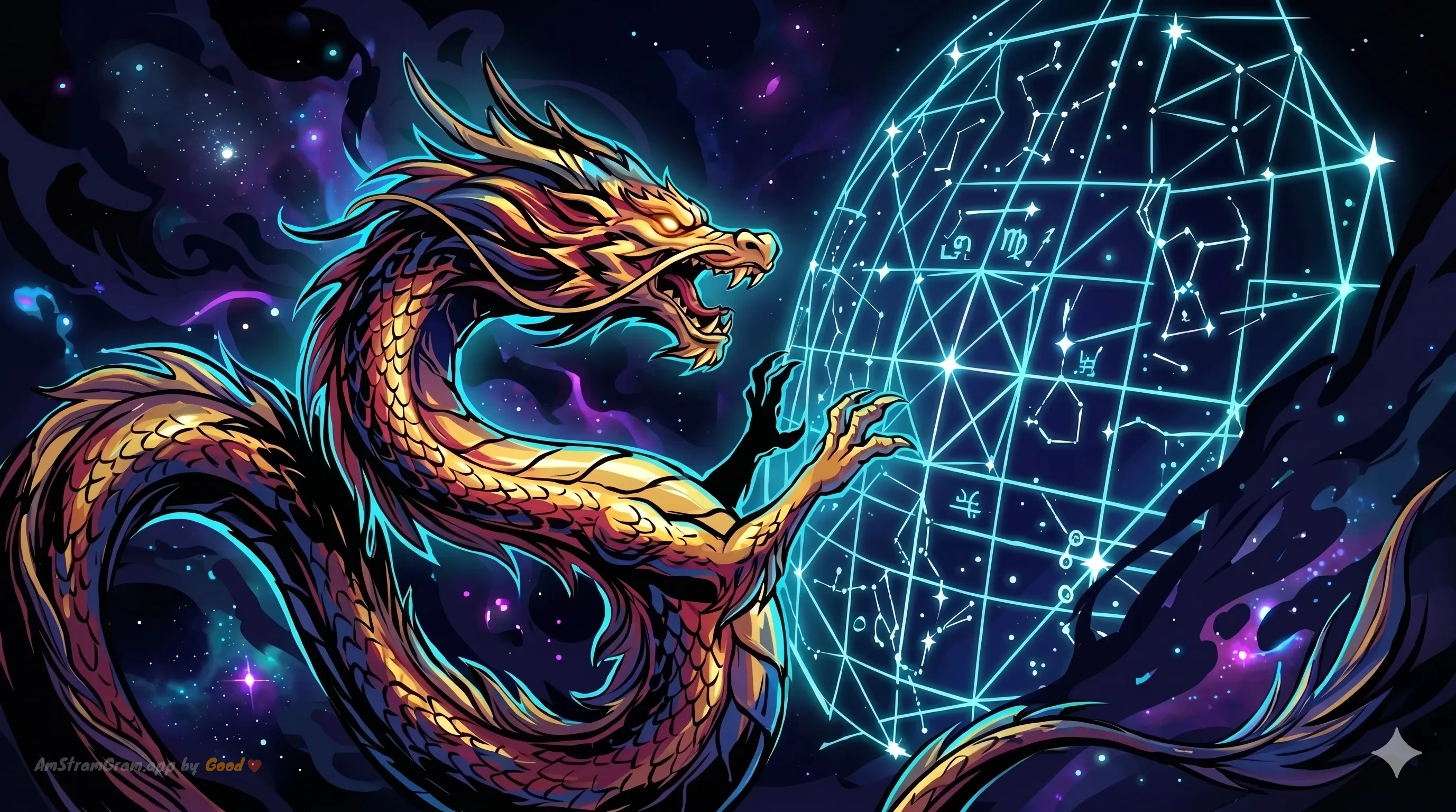
If you hunt for the Rat or the Dragon in a deep-sky atlas, you will not find them as a labeled star patch. The 12 animals of the shengxiao are time markers: a year, a place in a cycle, a collective mood—our Chinese zodiac guide already stresses how the calculation works. By contrast, the tropical zodiac you read in magazines ties the Sun sign to a slice of the ecliptic (the Sun’s annual ring), inherited from sky mapping—even though the tropical vs sidereal debate deserves its own chapter.
This article sets a clean line between sky chart and symbolic clock—and opens the door to the 28 lunar lodges and the Four Celestial Animals, which do belong to an authentic Chinese stellar tradition.
Two zodiacs, two grammars: spatial vs temporal
Picture two instruments: one notates where the notes sit on the staff; the other keeps the beat (how long each movement lasts).
West: a “spatial” reading
The classic zodiac tied to your Sun sign is anchored in the Sun’s path along the ecliptic, split into 12 sectors of 30°. Each sign borrows its name and part of its imagery from ancient constellations—star patterns civilizations projected onto the vault. Even in the tropical version (the most common in the West), the logic remains seasonal and sky-sector: where are we in the solar ring?
China: a “temporal” reading
The cycle of 12 animals structures time in year-long units (and, in some systems, double-hours). Its foundation is not “this constellation rises in the east” but which chapter of a large cycle we are crossing—often linked to Jupiter, whose real orbit is about 11.86 years: close to a dozen years, enough to feed the idea of a slow planetary rhythm pacing the world.
This is not a value ranking: both systems are languages. But words do not translate one-to-one—or we end up saying nonsense about the sky and history.
Western zodiac: a fresco tied to the vault (and the Sun)
Popular Western astrology relies on the tropical frame: 0° Aries marks the spring equinox, then we advance sign by sign. Each sign is a slice of solar space-time: you are a Leo because the Sun, seen from Earth, occupied that sector at birth—our 12-sign guide covers dates and traits.
The original constellations no longer line up perfectly with that grid (precession, tropical vs sidereal choice), but the intuition holds: where are we in the Sun’s yearly cycle? That is why people speak of a spatialized or seasonal astrology—even if contemporary psychology mainly reads archetypes.
The 12 animals: a wheel of time, not a star atlas
Shengxiao (生肖) pairs twelve archetypes with twelve years in a repeating cycle. Your birth-year animal tells a collective color, a social or existential mood—Wu Xing refines it further with Wood, Fire, Earth, Metal, and Water.
Jupiter, the discreet metronome
In astronomy, Jupiter loops the zodiac in a little under 12 Earth years. Astrological traditions worldwide noticed this slow giant: in China, tying the Jovian cycle to the 12 Earthly Branches (地支) cemented a way of thinking in planetary “chapters.” You do not need to believe in a direct gravitational pull to grasp the image: a great planet returning to the same sky position every ~12 years is a naked-eye cosmic clock for agrarian cultures.
So when you say “I’m a Pig,” you are not saying “my natal constellation is the Pig.” You mean: I was born in a given chapter of a large spiral—and that chapter dialogues with elements, leap years, social tides… not with a homonymous stellar alignment.
China’s true “constellations”: the 28 lunar lodges
If you want fine Chinese sky mapping, here is the jewel: the 28 lunar lodges (二十八宿, èrshíbā xiù). The Moon crosses the sky in ~27.3 days; its path was split into 28 segments, each tied to an asterism or star group used as an observational anchor.
What are they for?
- Calendar: marking nights, festivals, auspicious or sensitive windows (depending on the school).
- Practical astronomy: placing the Moon, planets, and comets on the vault.
- Symbolism: each lodge carries a poetic name (chariot star, crow, nine dragons…) feeding divination and poetry.
The 28 lodges are not the twelve animals of the popular zodiac: it is a different zoom level, closer to what a Western reader would call stellar segments. Confusing them is like mixing Sun signs and decans—each has its precision.
The Four Celestial Animals: dragon, tiger… as palaces of the sky
Another pillar of classical Chinese heaven: the Four Celestial Animals (四象, sì xiàng)—Azure Dragon of the east, White Tiger of the west, Vermilion Bird of the south, Black Tortoise of the north. They are not the twelve calendar animals; they are cosmological figures that quarter space, often tied to cardinal directions, Feng shui, and a worldview of dynamic balance.
Four palaces, one living map
Each animal “holds” a sky sector and a symbolism (east as wood, west as metal, south as fire, north as water—exact correspondences vary by text). The image is potent: threshold guardians between visible and invisible, city and mountain, yin and yang.
When a meme blends the annual zodiac Dragon with the Azure Dragon, the heart is right (shared imagination), but the astrologer must clarify: a social calendar (12 animals) and a directional cosmology (4 animals) do not live at the same scale.
Summary: how to read without getting lost
- Western zodiac (tropical): slices of the solar year, constellated heritage, read through the Sun’s position (and the full chart when you go deeper).
- 12 Chinese animals: chapters in a temporal cycle, resonating with the ~12-year Jovian logic, without a direct stellar obligation.
- 28 lodges: the true Chinese “lunar-stellar” mesh—separate layer.
- Four Celestial Animals: symbolic pillars of space—separate layer.
Keep this mental map: you gain credibility (experience, expertise, authority, trust) and, above all, reading pleasure—because a sky chart is always a story told with rigor and wonder.