Egyptian Mythology: Shai, Isis and the Magic of Fate
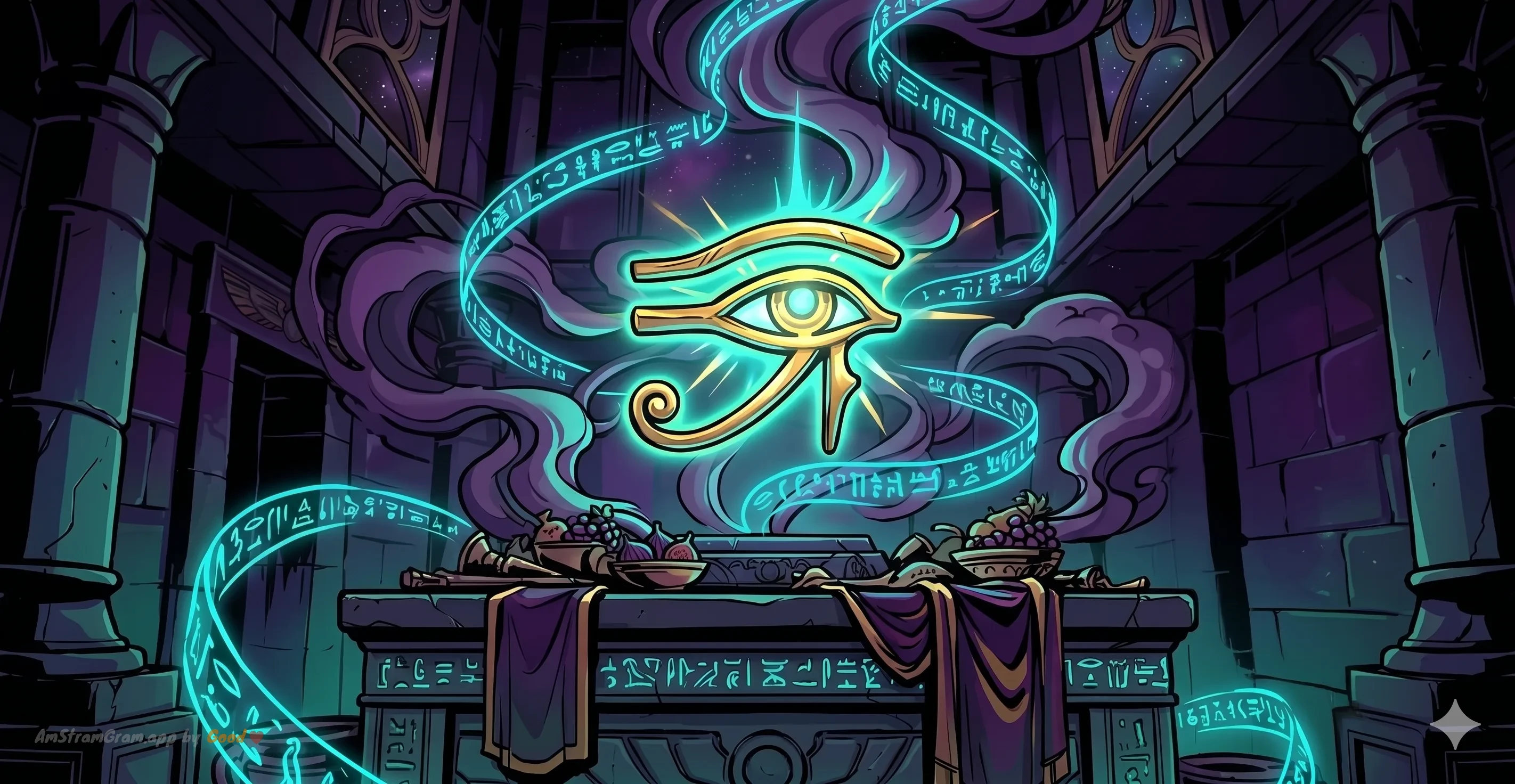
In the Egyptian universe, pure chance has no place: everything is governed by Maat (divine order) opposed to Isfet (chaos), magic and the decree of the gods.
Dive into ancient Egypt, where the Nile carries the millennial secrets of a civilization that shaped our understanding of destiny and magic. In this highly structured universe, what we call today chance or luck does not exist in the modern sense. The Egyptian universe rests on a fundamental principle: Maat — divine order, cosmic balance, truth and justice — constantly opposes Isfet, destructive chaos. In this world where every event is the fruit of divine will or magical decree, the Egyptians developed a sophisticated vision of destiny, fortune and the creative power of words and rituals.
This article guides you through the sands of time to discover the deities who governed the fate of mortals: Shai, the god of fate who is born with each individual; Renenutet, the cobra goddess of abundance and good fortune; Thoth, the master of wisdom and Heka, this primordial magic that allowed humans to influence their destiny. You will understand why, for the ancient Egyptians, uttering an incantation or writing a name was not a simple gesture, but an act of power capable of forcing luck and changing the course of events.
Explore the Deity Codex
Discover all mythological deities — Greek, Norse, Egyptian, Chinese and Japanese — in our interactive Codex.
The Egyptian Pantheon and the Balance of the Universe
Before addressing the masters of destiny and magic, it is essential to understand the cosmic structure of ancient Egypt. The Egyptian pantheon is vast and complex, with deities that evolve according to eras and regions, but certain major figures transcend the millennia to embody the fundamental forces of the universe.
Ra (or Re), the solar god, is the creator and ruler of the world. Each day, he crosses the sky in his solar boat, bringing light and life. At night, he travels in the underworld, confronting the serpent Apophis who threatens to destroy cosmic order. This daily struggle symbolizes the eternal battle between Maat and Isfet. Osiris, for his part, rules over the realm of the dead. Murdered by his brother Set, then resurrected by his sister-wife Isis, he becomes the supreme judge during the weighing of the heart, this ritual where the deceased's soul is weighed against the feather of Maat to determine their fate in the afterlife.
Isis, the great sorceress, is perhaps the most powerful goddess in the Egyptian pantheon. Sister and wife of Osiris, mother of Horus, she embodies magic, healing and protection. It is she who, through her incantations and knowledge of Heka, manages to resurrect Osiris and protect Horus from Set's machinations. Her magical power is so great that she can even force the gods to obey her will. Anubis, the jackal-headed god, presides over funerary rites and guides souls to Osiris's tribunal. He watches over mummies and protects tombs, ensuring that the transformation process to the afterlife unfolds according to the rules of Maat.
Horus, the divine falcon, son of Isis and Osiris, represents legitimate royalty and protection. After defeating Set in an epic battle, he becomes the model of the pharaoh, the intermediary between gods and humans. These deities, and many others, work together to maintain cosmic balance. Every action, every ritual, every prayer contributes to strengthening Maat and repelling Isfet. In this system, nothing is left to chance: every event, favorable or unfavorable, is the result of a complex interaction between divine forces, magic and destiny traced from birth.
Shai and Renenutet: The True Masters of Destiny
At the heart of the Egyptian vision of destiny are two essential figures: Shai, the god of fate, and Renenutet, the goddess of fortune. Together, they govern the fate of each individual from birth to judgment in the afterlife.
Shai, the god of fate
Shai (or Shai) is one of the most fascinating and feared deities in the Egyptian pantheon. His name literally means "destiny" or "fate". Unlike other gods who exist independently of humans, Shai is born with each individual at the moment of birth. He is the inseparable companion of every human being, personifying the assigned life expectancy, the duration of earthly existence and the major events that mark this existence.
Shai follows the soul throughout its earthly life, recording every action, every choice, every moment when the individual conforms or deviates from Maat. When the hour of death comes, Shai accompanies the deceased on their journey to the afterlife, until the crucial moment of the weighing of the heart. In this solemn ceremony, the deceased's heart is placed on a scale against the feather of Maat. If the heart is lighter than the feather — a sign that the individual has lived according to the principles of truth and justice — they can access the fields of Aaru, the Egyptian paradise. If the heart is heavier, it is devoured by Ammit, the devourer, and the soul is condemned to eternal oblivion.
Shai is not a god one prays to change one's destiny — for destiny, once assigned, is immutable. He rather represents accepted fatality, the cosmic order that governs each existence. The Egyptians believed that knowing and accepting one's Shai was essential to living in harmony with Maat. This conception of destiny as an intrinsic and personal force differs profoundly from our modern vision of chance: for the ancient Egyptians, every event in life was foreseen, traced, inscribed in the great cosmic book from birth.
Renenutet, the goddess of fortune
Renenutet (or Renenutet) is often represented as a cobra goddess or a woman with a cobra head, a symbol of protection and power in ancient Egypt. Her name means "the nurse" or "she who nourishes", and she embodies abundance, fertility, material wealth and good fortune. Very frequently associated with Shai, Renenutet complements his function by bringing prosperity and material luck into the destiny traced by the god of fate.
Renenutet was particularly venerated in agricultural regions, for she presided over harvests and guaranteed the fertility of fields. Farmers invoked her to obtain good harvests, to protect their granaries and to attract abundance into their homes. But her influence extended far beyond agriculture: she was also invoked to attract luck in business, to protect children and to guarantee family prosperity. Amulets bearing her image were worn to attract her protection and blessing.
The association between Shai and Renenutet perfectly illustrates the Egyptian vision of destiny: Shai traces the path of life, determines the duration of existence and major events, while Renenutet brings wealth, abundance and material good fortune along this path. Together, they form a divine couple that governs both personal destiny and earthly prosperity, showing that for the Egyptians, fate was not only a question of lifespan, but also of quality of life and material wealth.
Thoth and the Power of Heka (Creative Magic)
If Shai and Renenutet govern destiny and fortune, Thoth (or Djehuty), the ibis or baboon-headed god, holds the keys to the most powerful force in the Egyptian universe: Heka. Thoth is the god of wisdom, writing, sciences, magic and the measurement of time. It is he who invented hieroglyphic writing and who records the decisions of the gods. But above all, he is the undisputed master of Heka, this primordial magical force that allows reality to be modified and destiny to be influenced.
Heka is not sorcery in the modern sense, nor a simple superstition. It is a fundamental cosmic force, present from the creation of the universe. Heka is the creative energy that allowed Ra to give birth to the world, and it is this same energy that gods, pharaohs and even simple mortals can use to influence events. In Egyptian thought, Heka is as natural and as real as gravity or sunlight.
For the Egyptians, uttering an incantation or writing a name is invoking fate and forcing luck. Words have creative power: pronouncing the name of a thing makes it exist or modifies it. Writing an enemy's name on a figurine and destroying it causes their downfall. Reciting the magical formulas of the Book of the Dead guarantees survival in the afterlife. This conception of the power of words explains why the Egyptians attached such importance to magical texts, inscribed amulets and precisely formulated rituals.
Thoth teaches Heka to other gods and initiated humans. Isis, the great sorceress, learned Heka from Thoth, and it is thanks to this knowledge that she manages to resurrect Osiris and protect Horus. Egyptian priests, heirs to this tradition, used Heka in temples to heal the sick, protect the living and ensure the proper functioning of the universe. Even simple mortals could use magical formulas, amulets and rituals to attract luck, protect themselves from misfortune and influence their destiny.
This vision of Heka as a modifiable force of destiny shows that, despite the fatality represented by Shai, the Egyptians believed in the possibility of influencing their fate through magic, prayer and appropriate rituals. Destiny was not totally fixed: it could be modified, improved or protected thanks to the power of Heka, provided one knew the right formulas and used them correctly. This belief in the possibility of acting on one's destiny through magic remains one of the most fascinating aspects of ancient Egyptian thought.
Senet: When the Game of Chance Becomes a Mystical Journey
One of the most revealing aspects of the Egyptian vision of destiny and chance lies in Senet, one of the oldest board games in the world. Appearing around 3500 BCE, this board game was much more than simple entertainment: it was a sacred ritual, a metaphor for the soul's journey in the afterlife and a way to communicate with the gods.
Senet was played on a board of thirty squares, arranged in three rows of ten. Players used pieces that they moved according to results obtained with throwing sticks — primitive dice made of marked sticks or small bones. These sticks, thrown into the air, determined the number of squares each player could advance. At first glance, it was a game of chance, like our modern dice games. But for the Egyptians, this was not the case.
The Egyptians believed that victorious dice throws were not the fruit of chance, but were guided by the gods. A game of Senet was considered an oracular consultation: the gods, through the results of the sticks, communicated their will and indicated the path to follow. Winning a game meant that the gods were favorable, that Maat was in balance and that destiny smiled upon the player. Losing, on the contrary, could be interpreted as a warning or a sign that one needed to rebalance one's life according to the principles of Maat.
More profoundly still, a game of Senet symbolized the journey of the soul in the afterlife. The squares of the board represented the different stages of the journey to the fields of Aaru, the Egyptian paradise. Some squares were traps — like the water square, where the player had to start over — symbolizing obstacles the soul had to overcome. Other squares were beneficial, representing divine protections. Reaching the last square meant successfully passing to the afterlife, like the soul that succeeds in the weighing of the heart and accesses the fields of Aaru.
This vision of Senet as a sacred ritual and divine consultation shows how much the Egyptians rejected the idea of pure chance. Even in a game that seems to depend entirely on chance, they saw the intervention of the gods and the manifestation of destiny. Today, we can use modern tools like our dice generator to make decisions or simulate draws, but the spirit remains the same: let fate decide, while recognizing that each result can have a deeper meaning than simple chance.
Senet was so important in Egyptian culture that examples are found in many tombs, accompanying the deceased on their journey to the afterlife. Pharaohs and nobles were buried with Senet boards made of ivory or precious wood, hoping to be able to continue playing and communicating with the gods in the other world. This practice shows the symbolic and religious importance of the game, far beyond its playful aspect.
Sources and References
To deepen your knowledge of Egyptian mythology, Heka, Shai and Senet, here are authoritative resources:
FAQ – Ancient Egypt and Destiny
Who is the Egyptian god of destiny and luck? +
Did the Egyptians believe in the evil eye? +
What is the power of Heka? +
Like the ancient Egyptians: let fate decide
Use our modern tools — dice, wheel of fortune, heads or tails — to make decisions, in the spirit of Egyptian Senet and Heka.
 Roll the Dice
 Spin the Wheel








💬 Commentaires
Chargement des commentaires…
Laisser un commentaire