How to Read the Tarot de Marseille: The Complete Beginner Guide
You want answers — but more than that, you want to trust your inner compass. Tarot de Marseille can be a clarity tool: not a verdict, a map.
Beginners often expect Tarot to “predict the future”. What makes it genuinely useful is something else: it helps you name what’s already there — tension, desire, fear, a decision you keep postponing.
In this guide, we’ll read the cards through a modern psychological lens: Tarot as a mirror of your inner state and a prompt for action. No dark mysticism. No fear tactics. Just a method you can repeat at home.
If you like self-reading tools, you may also enjoy our palmistry article: Reading palm lines: a simple palmistry guide .
The basics: the 22 Major Arcana (without the fog)
The Major Arcana are the 22 “big” cards of Tarot de Marseille. Think of them as a path: archetypes we all live through — impulse, doubt, structure, rupture, healing, renewal. Your goal isn’t to be “right” by the book; it’s to notice what the card activates in you.
A beginner-friendly way to read:
- One card = one question: “What am I avoiding?” “What step is ready?”
- One symbol = one emotion: attraction, irritation, relief — all are data.
- One message = one action: what can you do today, even small?
Quick meanings of the 22 Major Arcana (psychological angle)
- 0. The Fool — freedom, leap, trust with uncertainty.
- I. The Magician — initiative, resourcefulness, “start with what you have”.
- II. The High Priestess — intuition, patience, inner knowing.
- III. The Empress — expression, creativity, clarity.
- IV. The Emperor — structure, boundaries, commitment.
- V. The Hierophant — values, guidance, wise advice.
- VI. The Lovers — choice, desire, heart alignment.
- VII. The Chariot — direction, momentum, ownership.
- VIII. Justice — balance, truth, responsibility.
- IX. The Hermit — reflection, pruning, maturity.
- X. Wheel of Fortune — cycles, turning point, change.
- XI. Strength — gentle courage, self-mastery.
- XII. The Hanged Man — pause, new perspective, surrender.
- XIII. Death — transformation, endings that free space.
- XIV. Temperance — regulation, healing, rhythm.
- XV. The Devil — attachments, impulses, reclaimed power.
- XVI. The Tower — truth that breaks the illusion, liberation.
- XVII. The Star — hope, authenticity, inspiration.
- XVIII. The Moon — emotion, imagination, fog.
- XIX. The Sun — vitality, clarity, warm connection.
- XX. Judgement — awakening, call, next chapter.
- XXI. The World — integration, completion, belonging.
The method: the 3‑card spread (Past / Present / Future)
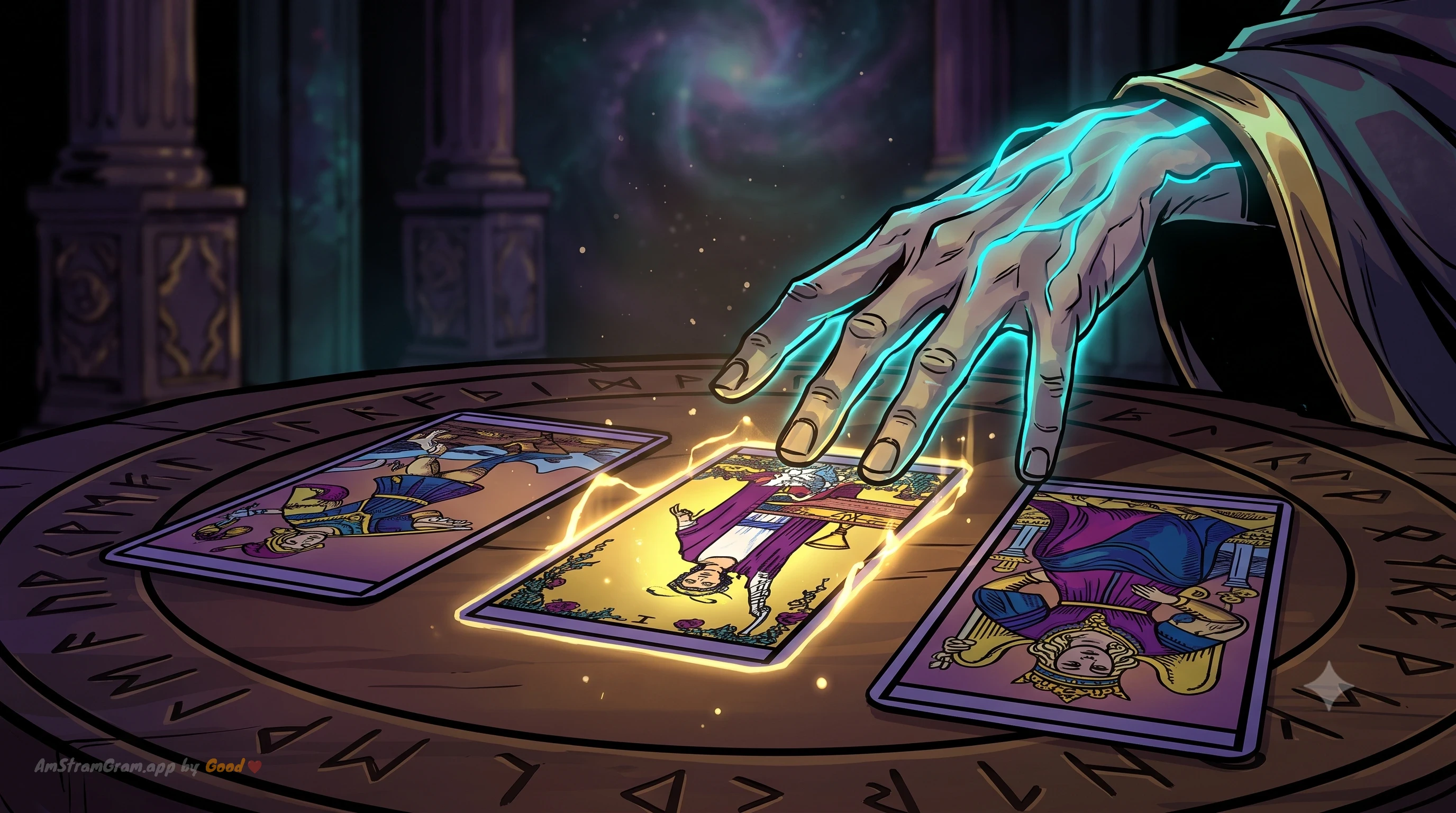
The 3‑card spread is ideal for beginners: simple, deep, repeatable. “Future” doesn’t mean destiny — think trajectory if nothing changes.
- Ask a clear question: “What should I understand about my work situation?”
- Shuffle while breathing slowly (30 seconds is enough).
- Draw 3 cards and place them left to right.
- Card 1: Past — roots, patterns, what brought you here.
- Card 2: Present — current energy, the pivot point.
- Card 3: Future — likely direction, next lesson.
- Connect the story: what repeats? what contrasts? what’s the next action?
🔥 Go further with your Birth Chart on AmStramGram
Tarot is great for clarity in the moment. A birth chart goes deeper: needs, strengths, blind spots, rhythms — a practical way to make choices with more self-trust.
 Explore my Birth Chart
Premium available • Integrated psychological interpretation
Quick tips to improve (without getting lost)
- Read first, book second: 60 seconds of raw impressions, then compare.
- Avoid yes/no questions: prefer “What would help me?”
- Write it down: 3 words per card. Patterns appear fast.
- Stay ethical: no medical claims, no fear predictions. Tarot serves clarity.